Archive for category stencils

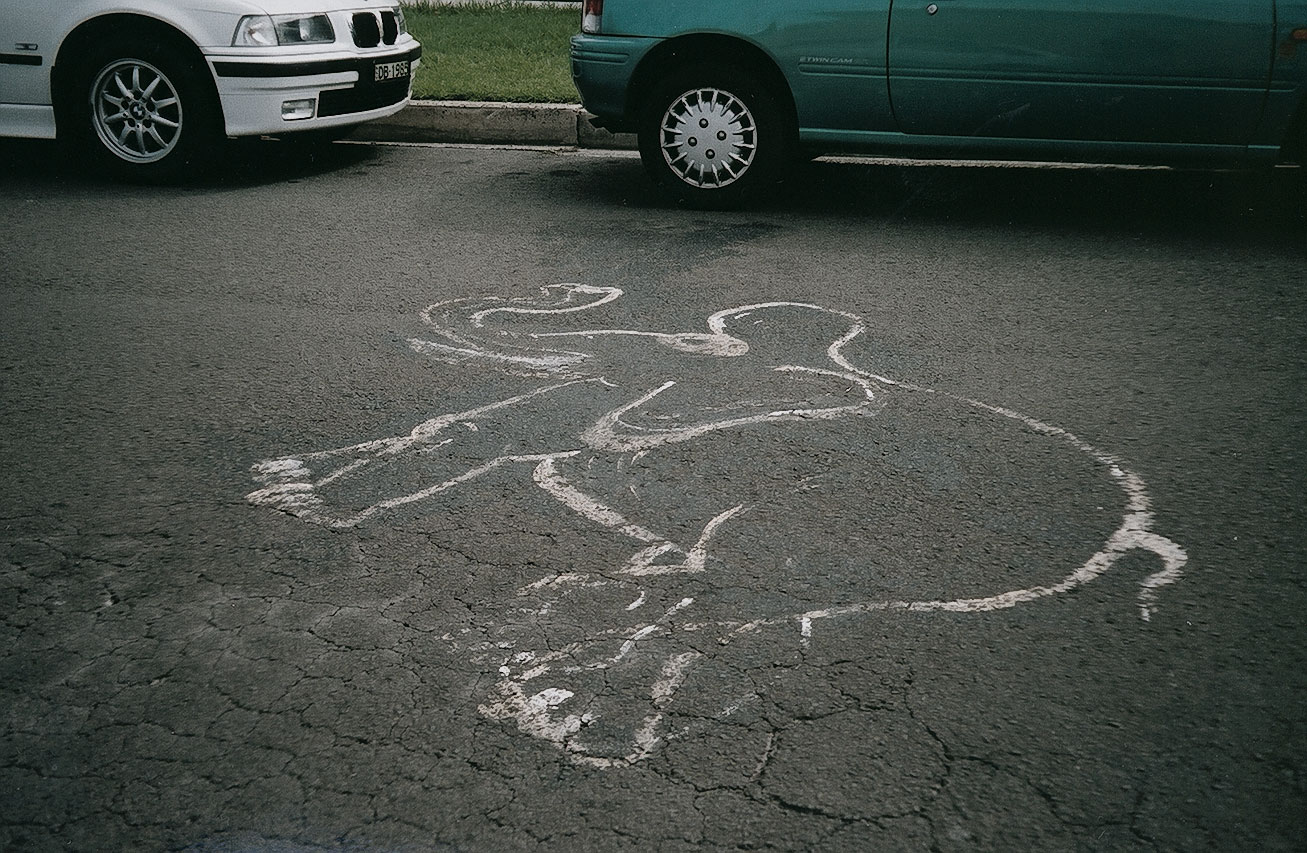
Mouse

Some things written in drying concrete probably don’t deserve to be preserved – trivial thoughts impetuously scribbled. But other inscriptions are sincere and loaded with meaning. When someone declares their love in the concrete, what are they thinking? Do they mean that their love will go on forever? Or do they simply want create a permanent memento of this romantic moment in their lives? Or are they casting a spell in the hope that the object of their love will reciprocate?

Observant pavement-watchers can sometimes follow the progress of a love story over a period of time.

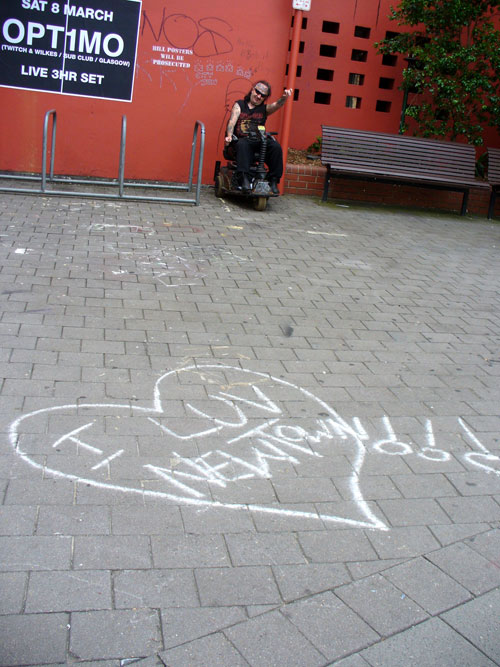
This wet concrete inscription was photographed on the night it was made in June 2008.

'I heart Mouse', Liberty Street, Enmore, June 2008

This stencil appeared not so far away three years later.

'Marry me Mouse', Enmore Road, Enmore, August 2011

I wonder if they are related?

, , , ,

No Comments

Newtown


'I have a dream' Square, King Street, Newtown, 2008


A while ago I came across this description:

King Street, Newtown is always more or less busy, but on Saturday night it is seen at its best and brightest.  Fancy a double line, more than a mile long, of brilliantly lighted shops; and “side-walks” so inconveniently crowded that it is often a matter of some difficulty to push one’s way through the throng of people on business and on pleasure bent.

The description seems fairly accurate to me, although it does not mention the vehicles that crawl up and down King Street on a Saturday night while their occupants ogle the crowds on the footpath. But that would be because this passage comes from an article in the June 1889 issue of the Sydney Illustrated News. King Street has been a commercial success for more than 150 years while the demographics of Newtown have ebbed and flowed.

Readers of this blog will have noticed that many of the pavement graffiti examples that I mention were photographed in Newtown. There are two main reasons for this – I live close by; and Newtown is a hub of graffiti activity. In fact, it was small esoteric stencils on the footpaths of Newtown that sparked my interest and prompted me to start my collection of pavement graffiti photographs in 1999.

Stencil publicising The Blair Witch Project movie, King Street, Newtown, 1999

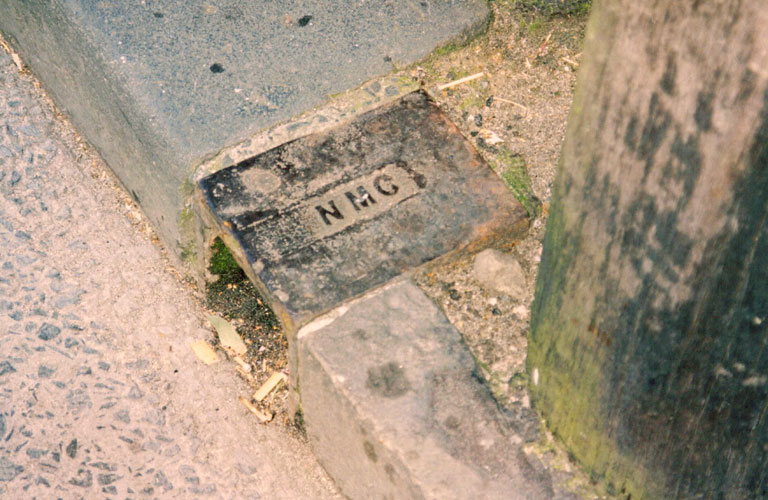
Newtown was incorporated as a municipality in 1862. Cast iron roof-water outlets set into the kerb In King Street still bear the letters NMC, even though Newtown Municipal Council ceased to exist in 1949. These days part of Newtown is included in the City of Sydney, while the remainder falls within the Marrickville local government area.

Roof water outlet to gutter with embossed letters ‘NMC’, King Street, Newtown, 1999

I have discovered that this kind of information and much more is available on the Newtown Project website, which has been created by the City of Sydney Archives and various volunteers to bring together historical information about the Municipality of Newtown. The information ranges from Council Minutes to the history of the street-art group Unmitigated Audacity, whose works included the I Have a Dream mural. There is a self-guided walking tour and plus lots of early photos of Newtown streets, buildings and people – and  contemporary photos as well. Definitely worth a look.

, , , , , , ,

No Comments

Wilson Street

When I posted a photograph of an embellished ‘bicycle route’ stencil in Little Eveleigh Street , near Wilson Street, back in March 2010, I suggested that the bike rider with a giant penis was not simply a joke but an expression of tension between local residents and the ‘greenies’ who cycle through on the way to and from the city.

It seems I was not wrong. The battle between cyclists and locals has escalated in this neighbourhood. In August 2010 I posted another photo from Wilson Street, this time a verbal blast: Eco-cycle rapists. This week on a walk through Darlington I found another angry notice, still readable even though it has been hashed over:  Attention bike Nazis no entry!

Wilson Street is a long back street stretching from Redfern Station to Newtown Station, and passing through Darlington and MacDonaldtown on the inner-city fringes of Sydney. It has been undergoing change for some years. Its corner shops have become art studios; Sydney University threatens to engulf it as it devours real estate to the north; and along the street’s southern side the former Eveleigh Railway Workshops – which would have provided employment for many residents of the little terrace houses in years gone by – have been turned into a theatre and arts centre. ‘Gentrification’ is the name of the street drama that is being performed here daily.

Whenever I visit Wilson Street it never fails to provide me with material for my pavement graffiti collection. This week, not far from the warning to cyclists, I noticed a worn little stencil in the middle of the road: Save the shark. According to other bloggers it’s been there a few years.

Near the ‘CarriageWorks’ cultural centre, some fairly recent wet concrete scratchings include an Aboriginal flag. In the background of this photo you can see the Skippy Girls painted on the corrugated iron fence.

, , , , , ,

No Comments

Elephants on parade

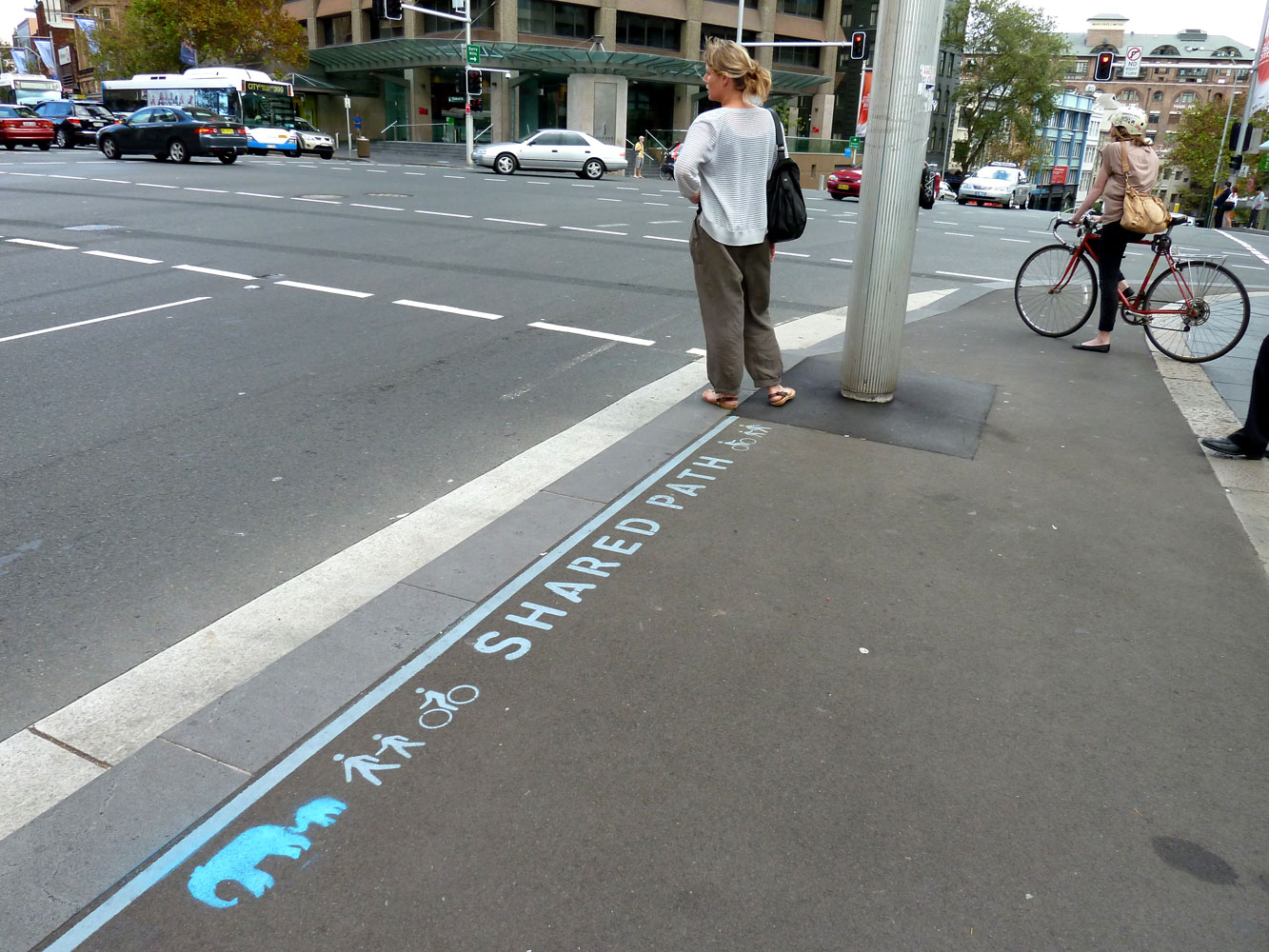
Shared path, College Street at Whitlam Square, Sydney, 2011

The relationships between cyclists, motorists and pedestrians are fraught and while some people are pleased with the new cycle lanes and shared pathways being installed by the City of Sydney, others are not. So it’s nice to see that some people have managed to keep their sense of humour.  Congrats  to the anonymous stenciller for this embellishment of a sign on the corner of College and Liverpool Streets, and thanks to the good sports in the Cycling Strategy department at the City of Sydney for drawing it to my attention.

And while pondering the similarities (if any) between an elephant’s thick skin and the wrinkled greyness of the asphalt, I thought I’d dig out a couple more pavement pachyderms from my archives.

Elefant Traks music label, King Street, Newtown, 1999

Asphalt elephant, Queens Parade, Wolllongong, 2003

, , , , , , , , ,

No Comments

Nabbed on the footpath

Pavement advertising in Sydney has moved on since 1904. In that year bootmaker Joe Gardiner was nabbed by the police for whitewashing advertisements for his shop on the asphalt in Oxford Street near the entrance to Hyde Park. Joe’s fate is recorded in a correspondence file in the City of Sydney archives.

These days the footpath is a billboard, not only for small shops and garage sales, but also for corporations. In recent months NAB (National Australia Bank) has discovered the transgressive frisson of stencilling the pavement. At Sculpture by the Sea in November, advertisements on the Bondi to Tamarama walk made it evident that NAB was a sponsor of the event. On Valentine’s Day in February, city pavements were enlisted in a multiple media campaign announcing that NAB had split up with the other banks (whatever that means). Although these commercially creative works soon faded in the rain, their smeary remains are still visible in some places.

Sculpture by the Sea, Bondi-Tamarama, November 2010. In the background is Lucy Barker's installation 'Sea Cells'.

Defacing the pavement with any kind of marker is still illegal in the City of Sydney but, as I noted in an earlier blog post, perhaps council rangers have given up bothering about graffiti drawn with chalk or quasi-chalk.

Valentine's Day 2011, Newtown Bridge.


You can read more about footpath decoration and pavement advertising in two articles I have written:
Hicks, Megan. 2009. Horizontal billboards: The commercialization of the pavement. Continuum: Journal of Media and Cultural Studies 23 (6):765-780.
Hicks, Megan. The decorated footpath. Dictionary of Sydney.

, , , , , , ,

No Comments

Wacko stencils (Guest spot)

Canberra writer Doug Fry has been travelling in the USA. This is his second guest blog about Pavement Graffiti.

Wacko, the self-described “premiere pop culture emporium of Los Angeles”, is located in the Los Feliz area – a suburb that’s affluent by real world standards, but decidedly middle class in LA terms. The store is part of a trifecta of hipster shopping opportunities on the eastern end of Hollywood Boulevard – just next door is Ozzie Dots, a novelty costume specialist that also carries overpriced second hand clothing. Barely a block away is Goodwill, the USA’s (approximate) equivalent of Salvos/Vinnies-type thrift chains. So, if you need a costume for Halloween when you’re in LA, Ozzie Dots and Goodwill can provide the clothing – Wacko, on the other hand, will provide the accoutrements.

The store sells all manner of trinkets and novelty items (Japanese conceived, Chinese made), along with a decent selection of books – a lot of indie and one-print-run-only titles, along with more ‘mainstream’ books covering everything from the early days of punk to the final days of the Manson Family. Finally, there is a permanent gallery space tucked up the back of the store; when I visited, the gallery was displaying a series of airbrushed paintings that were, as best I could tell, attempting to convey Alice In Wonderland-via-Dante’s Inferno (with LSD as the catalyst, and Dr Freud as executive producer).

I never established why the steps and pavement in front of Wacko have become an apparent mecca for stencilling and graf. Sure, its customer base would undoubtedly include a good many street artists, but what’s the ritual here? Do they celebrate their purchase of a marijuana-themed toilet seat by adding their latest stencil to the sidewalk? Or did someone arbitrarily spray the space one night, and unwittingly spawn a meme? Is this customer-customised livery actively encouraged by store management? And how does the City of LA feel about this communal modification of its grimy pavement?

, ,

No Comments

Tumbarumba tar

The first time we passed through Tumbarumba I loved the place. It had already started snowing higher up the mountains and in Tumbarumba the cold rain tinged the main street with a romantic grey patina. Icy water flowed down the gutters and the café where we ordered soup had books to read and a log fire burning.

This time we visit on New Year’s Eve and I am reminded that the midsummer sun is a great leveller, the glare off the asphalt erasing any architectural features of distinction. The main street of Tumbarumba might belong to any country town, with its mix of verandah post and IGA Supermarket aesthetics, the Lotto posters on the newsagency window, the racks of synthetic Made-in-China clothes standing outside once-glorious retail emporia, the same flies, the same listless teenagers flicking chips at each other as they suck Cokes at plastic tables outside the take-away. The cosy café we remember is closed for the Christmas-New Year period.

What perhaps distinguishes Tumbarumba are the dead, undecorated Christmas trees strapped to every verandah post and traffic sign – an odd civic nod to the festive season. In the heat they give off the nostalgic piney smell of Christmases past.

Sunset in Tumbarumba

And the pavements? The only embellishments I find are yellow stencilled shoe prints – perhaps the remnants of some heritage trail (you can just make out a pair of them in the photograph) – and one-inch square bathroom tiles, some red, some blue, randomly and very sparsely pressed into the concrete footpath.

As we squint at this streetscape a water truck trundles by sprinkling water, not to settle the dust (recent floods here have eliminated dust), but to cool the melting asphalt. Too late for us. We are standing in the shade of the pub awning, gouging tar and stones from the soles of our Crocs, collected mid-afternoon when we stepped out of the car in a side street.

Happy New Year to all.

, , , , ,

2 Comments

Expletive deleted

Cadigal Reserve, Summer Hill

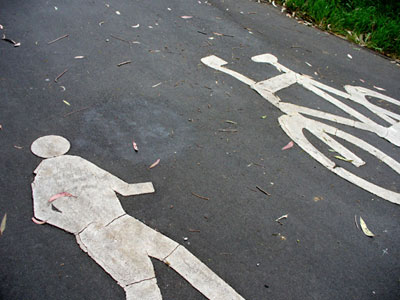
The signs, symbols and graffiti on the ground are all evidence of a territorial battle that is being waged among government authorities, property owners, motorists, cyclists and pedestrians. Now the stencils themselves are getting in on the act. It is clear that this walker has cracked up and has said something sharp to the bicycle. But a zealous graffiti obliterator has painted over his speech balloon and now we’ll never know what it was he said.

These particular stencils are on a pathway in Cadigal Reserve in Summer Hill. The pathway continues along beside Hawthorne Canal, which eventually runs into an arm of Parramatta River. 

The canal has a history of successive waves of pollution. Originally a stream called Long Cove Creek by early European settlers in Sydney, by the late 1800s it was fouled with house slops and the run-off from factories and slaughterhouses. The stink that it gave off was considered to be a health hazard and eventually it was excavated, re-aligned and lined with concrete in 1895 and renamed Hawthorne Canal.

But over the years the stormwater it collects has still been polluted with leaking sewage and dirt, horse manure, oil, chemicals, plastics, heavy metals and garbage washed off the roads and nearby rubbish dumps. And then, some time in 1990s, the canal was subjected to what some people regard as visual pollution – graffiti.

Hawthorne Canal, Summer Hill

Taggers and graffiti artists continue to express themselves on the walls and under the bridges there. Their marks have spread to the pathway beside the canal. Government authorities and a bush regeneration group have done much to improve the banks of the canal in recent years, so it is understandable that they might want to remove ‘unsightly’ graffiti from the asphalt. They can’t win though. More pavement graffiti has appeared since the last applications of grey paint. But I wish I had been there before they covered up that pedestrian’s outburst.

(Some of the information for this post was obtained from Hawthorne Canal – the history of Long Cove Creek, written by Mark Sabolch and published by the Ashfield & District Historical Society in association with the Inner West Environmental Group in 2006)

, , , , , , , ,

No Comments

Texture

Victoria Park Pool, Camperdown NSW

I am showing off these photographs today simply because I love the texture of worn pavement signs.

Harris Street, Ultimo NSW

, ,

No Comments

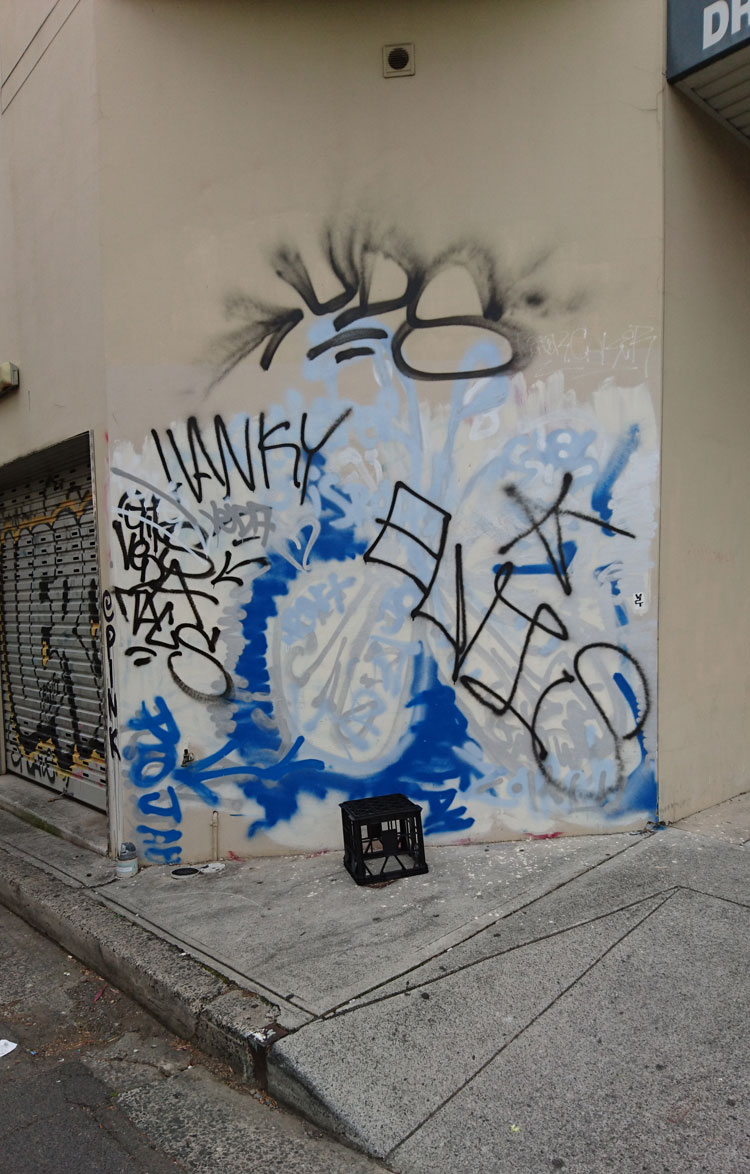
May Lane

The wall art in May Lane is often in the news. This time it’s on page three of the Sydney Morning Herald because there is going to be a national tour of panels from this laneway in St Peters, setting off in October. It all started about five years ago with Tuli Balog encouraging graffiti writers to do pieces on the wall of his picture-framing factory. Kurt Iveson has written about it in his book Publics and the city (Blackwell Publishing, 2007).

But the graffiti on the pavement in May Lane is never mentioned. Walk up and down the lane, though, and you will find all sorts of deliberate and accidental art decorating the gutters, along with the signatures of people whose wall pieces have long since been covered over.

POSTSCRIPT  – Since I wrote this post, May Lane has become the subject of discussion at Marrickville Council (not for the first time). Here’s a report by an onlooker of the discussion at the meeting on 9 November 2010. It’s on the Saving Our Trees website, although I don’t quite get the connection.

, , ,

4 Comments